About
A small range, made properly.
TexSocks exists because most novelty socks are a printed picture of a joke. We wanted one that holds up when someone actually looks down.
Who makes them
TexSocks is a small range from TeXoX LLC. The socks are knitted crews that look like cowboy boots — not a print pressed on top — in one unisex size. Every order is packed in Bastrop, Texas.
Knitted, not printed
This is the whole design decision, and everything else follows from it. A printed sock is a flat image pressed onto fabric — it looks right in the listing photo and starts cracking after a few washes. Ours is knitted: every color in the boot pattern is a separate yarn worked into the sock as it's made.
It costs more and it limits how fine the detail can be. In exchange, the pattern has actual texture, it can't peel, it won't fade out, and you can see the design mirrored on the inside. That's why people look twice — a printed boot reads as a picture, and a knitted one reads as a boot.
How they're made
Each colorway is designed in the US — the shaft pattern, the placement of the pull tab, where the black foot meets the mustard, how high the cuff sits. Mustard & Black is manufactured in the United States in North Carolina. Camel & Brown and Pink & Cream are packed in Bastrop, Texas (we do not claim a manufacture country for those two). The socks are knitted to order on machines built for multi-color jacquard knitting.
We say that plainly because it matters: we're the designer, not the mill. It's the arrangement behind most small clothing brands, and it's the reason a range this small can exist at all.
Why a small range
Three colorways, and that's the whole range. We'd rather put out a handful of designs that are right than fill a page with variations nobody asked for. Each one is a different idea of the same boot — blocked in with solid color, drawn in outline, or worked in leather tones — rather than one file recolored five times.
Designing a boot you can knit
A cowboy boot is mostly curves. Knitting is mostly grids. The whole design problem was getting one to survive the other.
A knitting machine builds a sock stitch by stitch in rows, so every line in the pattern has to land on a stitch — there's no in-between. Draw the scrollwork too fine and it disappears into the yarn. Draw it too bold and the boot turns into a blob. The first thing that had to go was detail; the second was the assumption that more color makes a better picture.
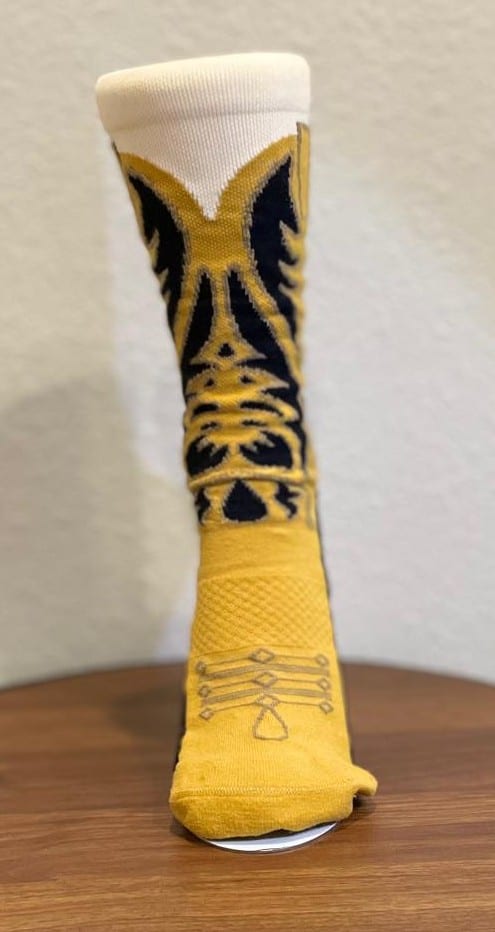
What survived is the shortlist of things that actually make a boot read as a boot: the scrolled stitching up the shaft, the notch at the top, the little pull tab, and the seam running down the vamp. Mustard adds a black heel and toe; pink is cream with hot pink line-work. Miss those cues and people see a patterned sock. Keep them and they double-take.
Three answers to the same question
The three colorways aren't one design recolored. Each is a different way of solving the same problem, which is why the range stops at three.
- Mustard & Black blocks the pattern in with solid color. It's the boldest and the most legible from a distance — the scrollwork reads as shapes, not lines.
- Camel & Brown goes the other way: real leather tones, with the boot drawn in fine dark stitch lines. It's the one that fools people, because it isn't trying to be a graphic at all.
- Pink & Cream drops the fill entirely and traces the whole boot in outline, doubling and trebling the lines until the shaft looks like a contour map. It reads as a graphic across the room and as a boot up close — the reverse of the other two.
Made in small runs
The designs are ours. The knitting is done to order by a manufacturing partner with the machines for multi-color jacquard, which is not a thing you can do in a spare room. We say that plainly because some people care, and because it's the arrangement behind most small clothing brands whether they mention it or not.
Runs are small — around a hundred pairs per colorway. That's deliberate. It's enough to find out whether a design works and few enough that a bad one isn't sitting in a box for three years.
What we won't do
- Invent reviews or sales numbers. When there are real ones, they'll go up with the real number attached.
- Run a fake countdown. The socks aren't running out this afternoon.
- Promise a delivery date we can't hit. The estimates on the shipping page are the honest ones.
How to reach us
TeXoX LLC · Bastrop, Texas. Brand: TexSocks.
Orders, sizing, and returns: support@texsocks.com. Shop counters and wholesale: sales@texsocks.com. Full contact page: Contact →
Shops: sample set first, then the $110/10 box with free US shipping when ready. Sample-first shop terms →
A pair is $15 plus $6.95 shipping. The three-pair set is $36 delivered.